Bus
Definition
It represents a multiphase node in the network that other elements (loads, lines, transformers, voltage sources…) can connect to. A bus is a node where the voltage is computed during the load flow analysis.
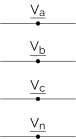
No equation is added for a bus.
Available Results
The following results are available for all buses:
Result Accessor |
Default Unit |
Type |
Description |
|---|---|---|---|
|
\(V\) |
complex array |
The potentials of each phase of the bus |
|
\(V\) |
complex array |
The phase-to-neutral voltages if the bus has a neutral, the phase-to-phase voltages otherwise |
|
\(\mathrm{pu}\) |
number array |
The per-unit voltage levels: (\(\sqrt{3} V_{pn} / V_\mathrm{nom}\)) if the bus has a neutral, (\(V_{pp} / V_\mathrm{nom}\)) otherwise |
|
- |
boolean array |
Indicates if the voltage levels violate the limits |
Additionally, the following results are available for buses with a neutral:
Result Accessor |
Default Unit |
Type |
Description |
|---|---|---|---|
|
\(V\) |
complex array |
The phase-to-neutral voltages of the bus |
|
\(\mathrm{pu}\) |
number array |
The voltage levels of each phase of the bus (\(\sqrt{3} V_{pn} / V_\mathrm{nom}\)) |
And the following results are available for buses with more than one phase:
Result Accessor |
Default Unit |
Type |
Description |
|---|---|---|---|
|
\(V\) |
complex array |
The phase-to-phase voltages of the bus |
|
\(\mathrm{pu}\) |
number array |
The voltage levels of each phase of the bus (\(V_{pp} / V_\mathrm{nom}\)) |
And the following results are available for three-phase buses:
Result Accessor |
Default Unit |
Type |
Description |
|---|---|---|---|
|
\(\%\) |
number |
The voltage unbalance of the bus according to the IEC, IEEE or NEMA definition |
Usage
A bus is identified by its unique id and must define the phases it is connected to. A bus must have all the phases of the elements connected to it.
import roseau.load_flow as rlf

bus1 = rlf.Bus(id="bus1", phases="abcn")  # A three-phase bus with a neutral
bus2 = rlf.Bus(id="bus2", phases="abc")  # A three-phase bus without a neutral
bus3 = rlf.Bus(id="bus3", phases="an")  # A single-phase bus

rlf.PowerLoad(id="load1", bus=bus1, powers=1000, phases="abcn")  # OK
rlf.PowerLoad(id="load2", bus=bus1, powers=1000, phases="abc")  # OK
rlf.PowerLoad(id="load3", bus=bus2, powers=1000, phases="ab")  # OK
rlf.PowerLoad(
    id="load4", bus=bus3, powers=1000, phases="ab"
)  # Error: bus3 does not have phase "b"
Since a bus represents a point in the network, it is possible to define the coordinates of this point:
import roseau.load_flow as rlf
from shapely import Point

bus = rlf.Bus(id="bus", phases="abc", geometry=Point(1.0, -2.5))
This information is not used by the load flow solver but could be used to generate geographical plots of the results.
Short-circuit
The bus element can also be used to create a short-circuit in the network to perform short-circuit analysis.
Here is an example of a simple short-circuit between two phases:
import functools as ft
import numpy as np
import roseau.load_flow as rlf

# Two buses
bus1 = rlf.Bus(id="bus1", phases="abcn")
bus2 = rlf.Bus(id="bus2", phases="abcn")

# A line
lp = rlf.LineParameters(id="lp", z_line=rlf.Q_((0.3 + 0.35j) * np.eye(4), "ohm/km"))
line = rlf.Line(id="line", bus1=bus1, bus2=bus2, parameters=lp, length=rlf.Q_(1, "km"))

# A voltage source on the first bus
un = 400 / rlf.SQRT3
vs = rlf.VoltageSource(id="source", bus=bus1, voltages=rlf.Q_(un, "V"))

# The neutral of bus1 is fixed at potential 0
pref = rlf.PotentialRef(id="pref", element=bus1)

# Create a short-circuit on bus2 between phases "a" and "b"
bus2.add_short_circuit("a", "b")

# Create a network and solve a load flow
en = rlf.ElectricalNetwork.from_element(bus1)
en.solve_load_flow()

# Get the currents flowing to the line from bus1
# Notice the extremely high currents in phases "a" and "b"
en.res_lines[["current1"]].transform([np.abs, ft.partial(np.angle, deg=True)])
# |               |   ('current1', 'absolute') |   ('current1', 'angle') |
# |:--------------|---------------------------:|------------------------:|
# | ('line', 'a') |                    433.861 |                -19.3987 |
# | ('line', 'b') |                    433.861 |                160.601  |
# | ('line', 'c') |                      0     |                  0      |
# | ('line', 'n') |                      0     |                  0      |
API Reference
- class Bus(id, *, phases, geometry=None, initial_potentials=None, nominal_voltage=None, min_voltage_level=None, max_voltage_level=None)
A multi-phase electrical bus.
Bus constructor.
- Parameters:
id (Id) – A unique ID of the bus in the network buses.
phases (str) – The phases of the bus. A string like
"abc"or"an"etc. The order of the phases is important. For a full list of supported phases, see the class attributeallowed_phases.geometry (shapely.geometry.base.BaseGeometry | None) – An optional geometry of the bus; a
Geometrythat represents the x-y coordinates of the bus.initial_potentials (ComplexArrayLike1D | None) – An optional array-like of initial potentials of each phase of the bus. If given, these potentials are used as the starting point of the load flow computation. Either complex values (V) or a
Quantityof complex values.nominal_voltage (float | Q_[float] | None) – An optional nominal phase-to-phase voltage for the bus (V). It is not used in the load flow. It can be a float (V) or a
Quantityof float. It must be provided if either min_voltage_level or max_voltage_level is provided.min_voltage_level (float | Q_[float] | None) – An optional minimal voltage level of the bus (%). It is not used in the load flow. It must be a percentage of the nominal_voltage between 0 and 1. Either a float (unitless) or a
Quantityof float.max_voltage_level (float | Q_[float] | None) – An optional maximal voltage level of the bus (%). It is not used in the load flow. It must be a percentage of the nominal_voltage between 0 and 1. Either a float (unitless) or a
Quantityof float.
- element_type: Final = 'bus'
The type of the element. It is a string like
"load"or"line"etc.
- property initial_potentials: Q_[ComplexArray]
An array of initial potentials of the bus (V).
- Return type:
- geometry = None
- property nominal_voltage: Q_[float] | None
The phase-to-phase nominal voltage of the bus (V) if it is set.
- add_short_circuit(*phases, ground=None)
Add a short-circuit by connecting multiple phases together optionally with a ground.
- propagate_limits(force=False)
Propagate the voltage limits to galvanically connected buses.
Galvanically connected buses are buses connected to this bus through lines or switches. This ensures that these voltage limits are only applied to buses with the same voltage level. If a bus is connected to this bus through a transformer, the voltage limits are not propagated to that bus.
If this bus does not define any voltage limits, calling this method will unset the limits of the connected buses.
- Parameters:
force (bool) – If
False(default), an exception is raised if connected buses already have limits different from this bus. IfTrue, the limits are propagated even if connected buses have different limits.- Return type:
None
- get_connected_buses()
Get IDs of all the buses galvanically connected to this bus.
These are all the buses connected via one or more lines or switches to this bus.
- property res_voltage_levels: Q_[FloatArray] | None
The load flow result of the bus voltage levels (p.u.).
See also
res_voltage_levels_pp: The phase-to-phase voltage levels of the bus. Raises if the bus has only one phase.res_voltage_levels_pn: The phase-to-neutral voltage levels of the bus. Raises if the bus does not have a neutral.
- Return type:
Q_[FloatArray] | None
- property res_voltage_levels_pp: Q_[FloatArray] | None
The load flow result of the bus’s phase-to-phase voltage levels (p.u.).
Raises an error if the element has only one phase.
See also
res_voltage_levels: The voltage levels of the bus in the natural representation (phase-to-neutral if it has a neutral, phase-to-phase otherwise).res_voltage_levels_pn: The phase-to-neutral voltage levels of the bus. Raises if the bus does not have a neutral.
- Return type:
Q_[FloatArray] | None
- property res_voltage_levels_pn: Q_[FloatArray] | None
The load flow result of the bus’s phase-to-neutral voltage levels (p.u.).
Raises an error if the element does not have a neutral.
See also
res_voltage_levels: The voltage levels of the bus in the natural representation (phase-to-neutral if it has a neutral, phase-to-phase otherwise).res_voltage_levels_pp: The phase-to-phase voltage levels of the bus. Raises if the bus has only one phase.
- Return type:
Q_[FloatArray] | None
- property res_violated: BoolArray | None
Whether the bus has voltage limits violations.
Returns
Noneif the bus has no voltage limits are not set.- Return type:
BoolArray | None
- allowed_phases: Final
The allowed phases for a terminal element are:
P-P-P or P-P-P-N:
"abc","abcn"P-P or P-P-N:
"ab","bc","ca","abn","bcn","can"P-N:
"an","bn","cn"
- property res_potentials: Q_[ComplexArray]
The load flow result of the element potentials (V).
- Return type:
- property res_voltages: Q_[ComplexArray]
The load flow result of the element voltages (V).
If the element has a neutral, the voltages are phase-to-neutral voltages for existing phases in the order
[Van, Vbn, Vcn]. If the element does not have a neutral, the voltages are phase-to-phase for existing phases in the order[Vab, Vbc, Vca].See also
res_voltages_pp: The phase-to-phase voltages of the element. Raises if the element has only one phase.res_voltages_pn: The phase-to-neutral voltages of the element. Raises if the element does not have a neutral.
- Return type:
- property res_voltages_pp: Q_[ComplexArray]
The load flow result of the element’s phase-to-phase voltages (V).
Raises an error if the element has only one phase.
See also
res_voltages: Get the voltages in the natural representation of the element (phase-to-neutral if it has a neutral, phase-to-phase otherwise).res_voltages_pn: The phase-to-neutral voltages of the element. Raises if the element does not have a neutral.
- Return type:
- property res_voltages_pn: Q_[ComplexArray]
The load flow result of the element’s phase-to-neutral voltages (V).
Raises an error if the element does not have a neutral.
See also
res_voltages: Get the voltages in the natural representation of the element (phase-to-neutral if it has a neutral, phase-to-phase otherwise).res_voltages_pp: The phase-to-phase voltages of the element. Raises if the element has only one phase.
- Return type:
- res_voltage_unbalance(definition='VUF')
Calculate the voltage unbalance (VU) on this element.
- Parameters:
definition (Literal['VUF', 'LVUR', 'PVUR']) –
The definition of the voltage unbalance, one of the following:
VUF: The Voltage Unbalance Factor defined by the IEC, also called the “True Definition” (default):\(VUF = \dfrac{V_\mathrm{2}}{V_\mathrm{1}} \times 100 \, (\%)\)
Where \(V_{\mathrm{1}}\) and \(V_{\mathrm{2}}\) are the magnitudes of the positive-sequence and negative-sequence voltages, respectively.
LVUR: The Line Voltage Unbalance Rate defined by NEMA:\(LVUR = \dfrac{\Delta V_\mathrm{Line,Max}}{\Delta V_\mathrm{Line,Mean}} \times 100 (\%)\).
Where \(\Delta V_\mathrm{Line,Mean}\) is the arithmetic mean of the line voltages and \(\Delta V_\mathrm{Line,Max}\) is the maximum deviation between the measured line voltages and \(\Delta V_\mathrm{Line,Mean}\).
PVUR: The Phase Voltage Unbalance Rate defined by IEEE:\(PVUR = \dfrac{\Delta V_\mathrm{Phase,Max}}{\Delta V_\mathrm{Phase,Mean}} \times 100 (\%)\).
Where \(\Delta V_\mathrm{Phase,Mean}\) is the arithmetic mean of the phase voltages and \(\Delta V_\mathrm{Phase,Max}\) is the maximum deviation between the measured phase voltages and \(\Delta V_\mathrm{Phase,Mean}\).
- Returns:
The voltage unbalance in percent.
- Return type:
- is_multi_phase: Final = True
Is the object multi-phase?
- property network: _N_co | None
Return the network the element belong to (if any).
- Return type:
_N_co | None
- id
- to_dict(*, include_results=True)
Convert the element to a dictionary.
- to_json(path, *, include_results=True, indent=True)
Save this element to a JSON file.
Warning
If the file exists, it will be overwritten.
- Parameters:
path (StrPath) – The path to the output file to write the network to.
include_results (bool) – If True (default), the results of the load flow are included in the JSON file. If no results are available, this option is ignored.
indent (bool) – If True (default), the JSON output is pretty-printed with 2-space indentation. Set to False for compact output.
- Returns:
The expanded and resolved path of the written file.
- Return type:
- results_to_dict(full=False)
Return the results of the element as a dictionary.
The results dictionary of an element contains the ID of the element, its phases, and the result. For example, bus.results_to_dict() returns a dictionary with the form:
{"id": "bus1", "phases": "an", "potentials": [[230.0, 0.0], [0.0, 0.0]]}
Note that complex values (like potentials in the example above) are stored as list of [real part, imaginary part] so that it is JSON-serializable
Using the full argument, bus.results_to_dict(full=True) leads to the following results:
{"id": "bus1", "phases": "an", "potentials": [[230.0, 0.0], [0.0, 0.0]], "voltages": [[230.0, 0.0]]}
The results dictionary of the network contains the results of all of its elements grouped by the element type. It has the form:
{
    "buses": [bus1_dict, bus2_dict, ...],
    "lines": [line1_dict, line2_dict, ...],
    "transformers": [transformer1_dict, transformer2_dict, ...],
    "switches": [switch1_dict, switch2_dict, ...],
    "loads": [load1_dict, load2_dict, ...],
    "sources": [source1_dict, source2_dict, ...],
    "grounds": [ground1_dict, ground2_dict, ...],
    "potential_refs": [p_ref1_dict, p_ref2_dict, ...],
}
where each dict is produced by the element’s results_to_dict() method.
- results_to_json(path, *, full=False, indent=True)
Write the results of the load flow to a json file.
Warning
If the file exists, it will be overwritten.
- Parameters:
path (StrPath) – The path to the output file to write the results to.
full (bool) – If True, all the results are added in the resulting dictionary, including results computed from other results (such as voltages that could be computed from potentials). False by default.
indent (bool) – If True (default), the JSON output is pretty-printed with 2-space indentation. Set to False for compact output.
- Returns:
The expanded and resolved path of the written file.
- Return type: